
Stage 2: Pamplona to Logroño
- Stephanie Heathfield
- May 15, 2023
- 5 min read

Updated: May 19, 2023
Via Puente La Reina, Estella and Los Arcos
97.6 km
I was convinced that it was going to be impossible to beat, or even match, the enjoyment of the first stage. Everything at the beginning of the Camino was so new, so exciting, so challenging and so motivating, all in equal measure. I took notice of everything around me, every minute of every day. I didn't want to miss any part of it. In fact on only Day 2 I mentioned to a number of people that, even at this early stage, "I never want this walk to end". In the first week the scenery had been quite breathtaking and so varied in the space of just a few short days. It was going to be a hard act to follow. Although I'd done a little research before embarking on this journey, I didn't want to delve too deeply into each section of the walk, as I wanted it to be an adventure and somewhat of a surprise; not being quite sure of what to expect next. On that basis I didn't really have any firm ideas about what the second stage would 'look like'. That said, I don't think my expectations were particularly high and I sort of expected to come down to earth with a bit of a bump.
However, nothing could have been further from the truth. I loved, loved, loved this section of the walk! If I had to summarise it, my overwhelming memories are of a multitude of poppies and a beautiful cacophony of birdsong. I'm not sure if it was because we were out in the countryside, or that it was spring, but I'm not sure I've ever heard louder birdsong. The sound of cuckoos (and often woodpeckers) could be heard most days, and multiple times a day. I don't know Spain that well, but having visited in the past it was always further South and during the summer months and my memories are of the countryside being quite parched and brown, but this section of the walk was lush and green. Again, not something I had been expecting and a very pleasant surprise.
The first stage of the Camino saw us walking in a South/South West direction from France as far as Pamplona. On reaching Pamplona the Camino then takes a completely Westerly direction until it reaches Santiago de Compostela, 22 miles East of the Atlantic Ocean.

One section of the walk I was particularly looking forward to was seeing the pilgrim sculptures at the top of a steep hill just outside Pamplona. The hill is called 'Alto del Perdón' which translates as 'Mount of Forgiveness'. The sculpture featured in the film 'The Way', which I referred to in my first blog post, and it captured my imagination and was something I was very keen to see for myself. The effort I put into reaching the top was suitably rewarded. My understanding is that the sculpture exhibits a small history of pilgrims and the pilgrimage… through various stages of development, from the beginning in the Middle Ages up to the present day, in the form of a procession. Of the twelve pilgrims, the first pilgrim appears to be searching for the route and symbolises the beginning of interest in the pilgrimage. Next is a group of three that depicts the growth or rise in popularity of the Camino. These three are followed by another group depicted as merchants or tradesmen on horseback that symbolise the medieval era of merchants hawking their wares to the pilgrims. Spaced away from them is a solitary figure that characterises the decline in pilgrimages due to political, religious, and social unrests from the mid-fourteenth to the mid-twentieth centuries. At the very end of the procession are two modern-day figures depicted to show the renewed interest and rise in popularity of the pilgrimage in the late twentieth century.
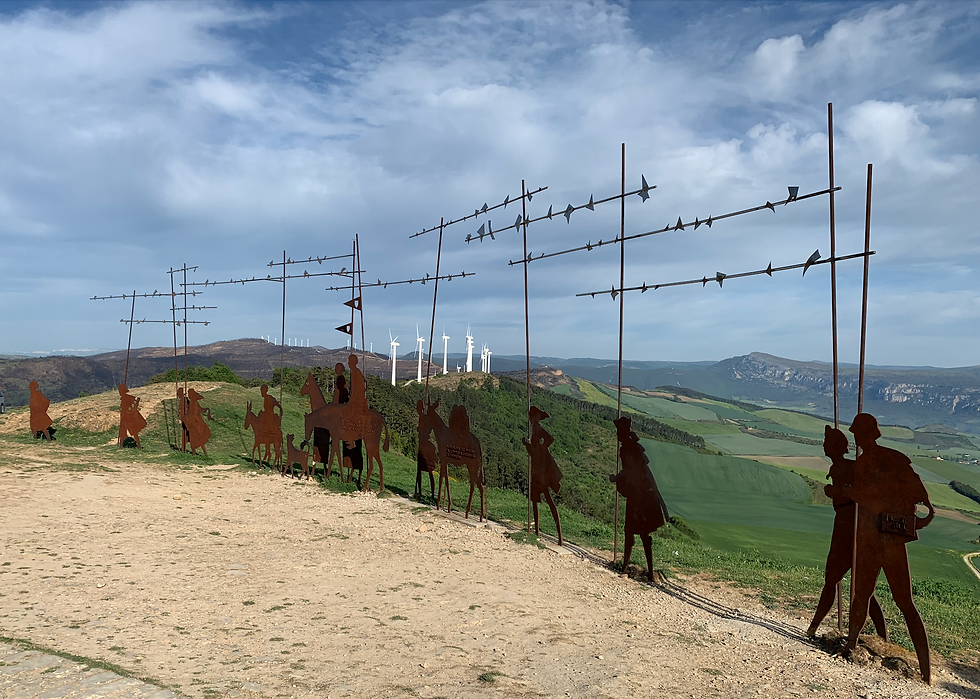
The iconic sculpture has graced the summit of Alto del Perdón since 1996 and inscribed on it are the words: Donde se cruza el camino del viento con el de las estrellas — “where the path of the wind crosses with that of the stars.” The summit is very exposed and hence very windy, with the most fantastic 360° views. I particularly enjoyed looking back over the city of Pamplona; testament to just how far I'd walked that morning, and how high I'd climbed. It was a clear day and looking West, with my back now to Pamplona, the views just went on and on. Somewhere out there in the distance was our planned destination, but we still had a fair few kilometres to cover before reaching Santiago. The summit's windy peak also has a slightly eerie feel to it as you stand in the shadow of a number of majestic and deceptively quiet, tall wind turbines.
The whole of this section of the Camino takes you through the region of Navarre. Navarre is the garden of the Basque Country and its gastronomy is influenced by the Basque cuisine. Along with all their excellent horticultural products, the region's top foods are cheese, red meat from the Pyrenees and wine. The weather had stayed hot since Pamplona (around 25/26 degrees) and this section felt very much like taking a leisurely walk through numerous olive groves and vineyards. The undulating green countryside with hilltop medieval villages reminded me very strongly of the hills in Tuscany.

I have to confess to one of the highlights of this section being a cup of Twinings English Breakfast tea. Around 3/4 of the way into a hot day's walk, with few villages to pass through and very little shade, we came across a random food truck parked in the middle of nowhere, complete with chairs, tables, umbrellas and an array of different teas, coffees and food on offer. It was so welcome and one of the best cups of tea I've had for a long time, so of course I ordered a second (apologies to those of you who are upset at seeing the teabag still in the cup after the milk has been added, but we're getting back to basics here, and needs must!)

This was also the section where I began to wear out the ends of my walking poles! Until a year ago I wouldn't have even considered using poles for walking. I've now reached a stage where I don't think I would ever walk without them. Apparently they can take up to 40% of weight from your knees. I also find that they generate rhythm and momentum so you can move more quickly. They can also help to sculpt and tone your arms and upper body but unfortunately I've yet to see any evidence of this.
Continuing highlights from this stage included meeting more new people from all over the world and perhaps even more amazingly . . . . still no blisters. I think I may just have found a 'secret weapon' on the blister prevention front, which I will share in a later post - assuming I still don't have any blisters at that point.
Pamplona to Puente La Reina:


Puente La Reina to Estella:


Estella to Los Arcos:





Los Arcos to Logroño:











Great to hear you’re still going strong and loving the experience. Great photos and please keep sharing them and your news!